“Do I Drink Too Much?” You Don’t Need to Hit Rock Bottom to Make a Change
Life can look fine from the outside while drinking takes up far too much room in your head. You’re allowed to want something different.
You don’t have to hit rock bottom to ask for help with drinking. If alcohol is taking up more time or headspace than you want, you can talk to your GP or an alcohol service. This article shares lived experience; it cannot diagnose a drinking problem.
“Do I drink too much?” can be a difficult question when your life looks fine from the outside. You don’t need to hit rock bottom before you question your drinking or ask for help. How much you drink matters. So does how it affects your life, and whether you can cut back when you want to.
Perhaps that’s why you’re here.
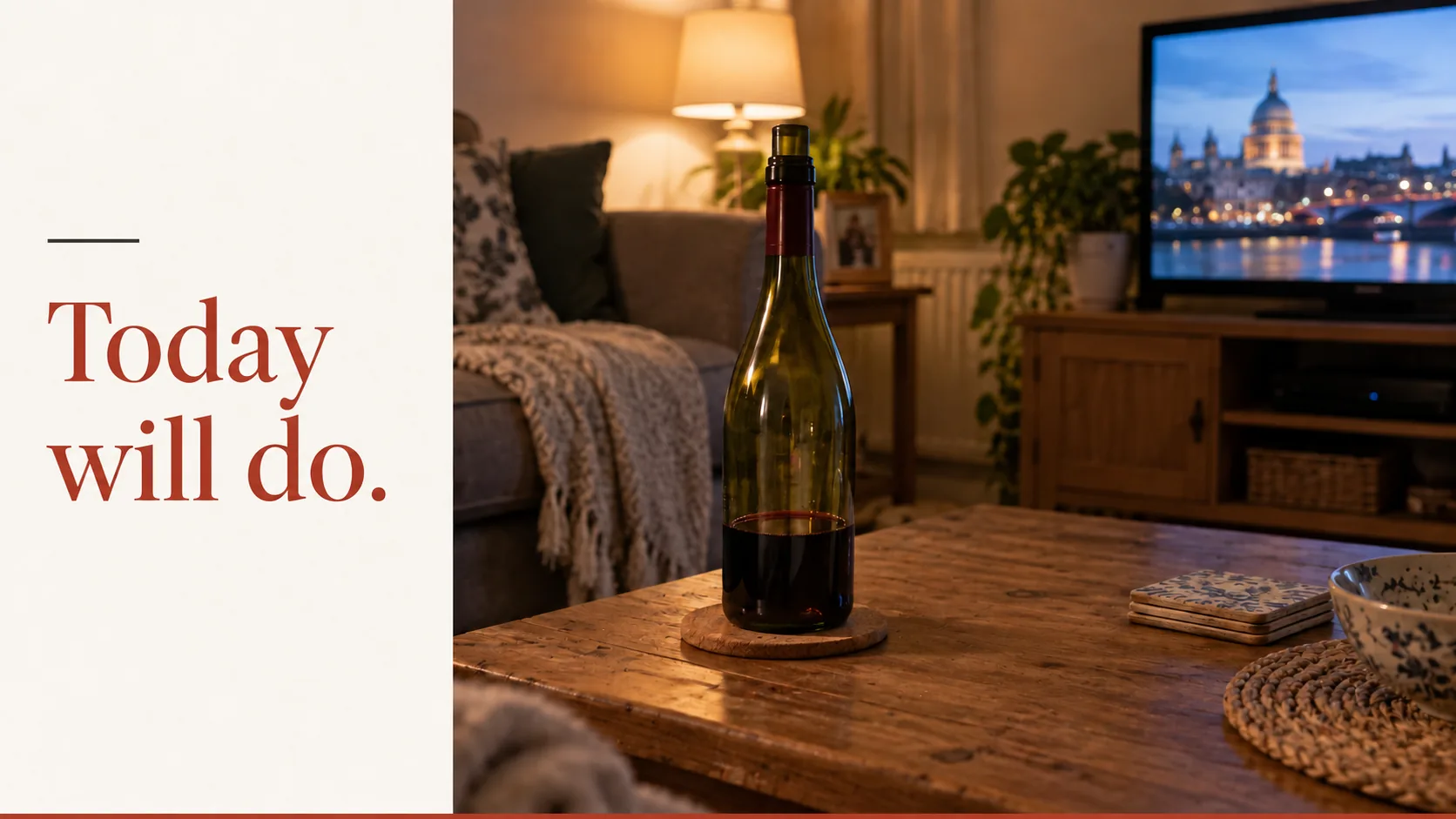
The television is on. The day is finally quiet. There’s a bottle on the coffee table with considerably less in it than you intended.
And somewhere between I deserved that and I’ll be better tomorrow, the question turns up again.
Do I drink too much?
You might immediately start building the case for no.
You go to work. You look after your family. You get things done. You know people who drink more.
So surely it can’t be that bad?
Am I drinking too much if my life looks fine?
I’m a mum of two, I’m married, and I work full time. I know the juggle.
For years, I’d start drinking while cooking dinner. But the thinking about it started long before that.
Was there enough wine for tonight? Did I need to pop to the shop? How long until five o’clock?
There were mornings full of regret and Mondays when I was certain things would change. By teatime, I’d be bargaining with myself again.
That back-and-forth took up so much space.
I didn’t have a dramatic turning point. After nearly twenty years in that cycle, I knew I needed things to change.
You’re allowed to want better
before things get worse.
You don’t have to collect enough terrible stories to earn the right to do something about your drinking.
How much alcohol is too much?
There is a practical answer as well as a personal one. In the UK, the guidance is not to regularly drink more than 14 units a week, spread over three or more days. That is a lower-risk guideline, not a guarantee of no harm. The NHS says there is no completely safe level of drinking. Read the NHS guidance on drinking less.
A glass isn’t a fixed unit. Its size and the strength of what you pour both count. Looking at the label and measuring your usual pour can give you a clearer picture than guessing.
But a weekly total can’t answer everything. If drinking is worrying you, making life harder, or proving difficult to control, that deserves attention too.
What signs are worth paying attention to?
The NHS lists regularly drinking more than you intended, struggling to reduce your drinking, and continuing despite problems with health, work or relationships among the signs of alcohol-use disorder. A professional can help assess what’s happening. This article cannot diagnose you. Read the NHS explanation.
You can also ask yourself a few honest questions:
- How often does “just one” become more than I planned?
- How much of my day do I spend thinking about drinking, buying it, or recovering from it?
- Do I keep making rules for myself that I find difficult to stick to?
- What is drinking getting in the way of?
- What would I like more room for?
This isn’t a scored test. There’s no pass mark and no verdict at the bottom.
It’s a chance to stop arguing your own concerns away for five minutes and listen to them.
“But other people drink more than me.”
They might.
That doesn’t tell you whether your drinking is working for you.
Someone else’s Friday night doesn’t make your Sunday morning feel any better. Their ability to leave half a glass doesn’t change how much effort you spend negotiating with yourself.
You don’t need to win a competition for who has it worst.
And you don’t need to decide what to call yourself before you ask for support. You can begin with something as ordinary as: “I’m worried about how much I’m drinking.”
What can I do next?
Start by being specific about what you’ve noticed. Write down what you drink and when, alongside what you hoped the drink would do for you. Help you relax? Mark the end of work? Fill a quiet evening?
Tell someone you trust if you can. You don’t need a polished explanation. “This is taking up more space than I want it to” is enough to start a conversation.
If you’re worried, speak to your GP or an alcohol support service. You don’t have to wait for a crisis to make that appointment.
If taking an alcohol-free day is safe for you, make a small plan for the time you’d usually pour a drink. There are some very ordinary, useful starting points in When Wine-O’Clock Hits: What to Do Instead of Drinking.
You don’t have to solve Christmas, your birthday and the rest of your life this evening. If that is what’s holding you back, read Does Quitting Drinking Mean Forever?
You can take the question seriously. You can get the right support. You can want things to change.
Even if nobody else thinks there’s a problem.
Forever feels big. Today doesn’t.
Today will do.
You don’t need
a rock bottom.
You don’t need a label or a dramatic story. If you want a little more room in your head, Today Will Do gives you somewhere to begin.
When it’s safe for you to take an alcohol-free day, make one decision. Come back for a little support when the bargaining starts.
You don’t have to work out forever.
What about today?